

The Great War — Season 5
93 Episodes · Premiered January 1, 2018 · Ended December 18, 2018
Episodes
In part two of the Adventures of Dunsterforce, we follow the Hush Hush Army on their travels through the Caucasus. Picking up where we left off, the Dunsterforce leave Enzeli, clash with Jangalis en route, and head for Baku. They had to journey through territory controlled by warlords, cossacks and bolshevik soviets and when they arrived during the Siege of Baku, Dunsterville and his men meet the five dictators that make up the Centrocaspian Dictatorship.
No synopsis available.
The Naval arms race of the early 20th century certainly meant that battleships got ever bigger and more powerful. But there is a David to every Goliath and so Motor Torpedo Boats were developed and used for "hit and run" style operations by both the British and the Italian Navy. Especially, the Italians used their Motoscafo armato silurante (MAS) with great success against the Austro-Hungarian Navy.
Indy talks to our weapons expert Othais about the Russian Pistols of World War 1.
Indy and Othais from C&Rsenal talk about Russian Rifles during World War 1.
The Czechoslovak Legion wanted to return home or continue the fight for independence even when peace on the Eastern Front was declared. But they needed to cross the whole of Civil War torn Russia for this.
The German Spring Offensive in 1918, the so called Kaiserschlacht or Operation Michael, was the biggest German offensive of World War 1 and Quartermaster Erich Ludendorff prepared his troops for this battle by incorporating everything the German Army had learned in this war until now. Hutier Infiltration Tactics, Georg Bruchmüller's artillery targeting and more lessons from the Eastern Front mean the Entente was facing a different Army than before.
Norway declared neutrality when the First World War broke out and as a nation with a large merchant fleet, profited from the war economically.
The time between the French defeat against Prussia in the Franco-Prussian War and the outbreak of the First World War is often described as the Belle Époque. But it certainly was a turbulent time for one of the major world powers too.
The French soldier in 1914 was already very different from the one in 1918 if you looked at his uniform or equipment. Also the combat tactics evolved considerably in four years of war. The Battle of Verdun, the Nivelle Offensive or the Battle of La Malmaison were important steps during that evolution in which the Poilu became a modern French soldier.
The French and British defenses during the German Spring Offensive 1918 were put to a real test when the Germans attacked. The carefully built defenses had to be abandoned and new lessons had to be learned.
Algeria, Tunisia and Morocco were all part of French North Africa before and during World War 1. They all contributed in material and men to the war effort and the French colonial soldiers were praised for their bravery.
The Battle for Alsace-Lorraine in the Vosges was unforgiving and brutal. Both the French and the German troops were fighting in extreme conditions for a extremely symbolic stretch of land.
German-Ottoman military cooperation predated World War 1 by a few decades. But their alliance during the First World War meant that German (and Austrian) troops would actually fight in and with the Ottoman Empire.
Submarines played a vital part in Germany's WW1 strategy. They would disrupt allied shipping despite the British Naval Blockade and ensue fear across the Atlantic and Mediterranean Sea.
Indy and Othais take a look at the US service pistols of World War 1.
No synopsis available.
No synopsis available.
Serbia's recent history before the outbreak of World War 1, was already shaped by internal struggles and external conflicts. It had fought countless wars with neighbors and rivals in changing alliances culminating in the two Balkan Wars 1912 and 1913.
The Austrian part of the dual monarchy that was the Austro-Hungarian Empire experienced the war quite distinctly and the inner political machinations directly influenced the outbreak of the war.
Great Britain was the center of a vast colonial empire and a rapidly changing world during the 19th and early 20th century. But what happened in the country in the years leading up to World War.
French tank development started almost simoultaneously with the British. The French tanks were very different in design based on a different understanding of the role of the tank on the battlefield. Arguably, the first modern tank, the Renault FT was a result of this development.
No synopsis available.
Financing and supplying the First World War was a huge economic undertaking that influenced the British, French, American and Italian economies profoundly and shaped the global balance of power.
After 4 1/2 years of war and millions of dead and wounded any kind of peace would be difficult. The peace process in 1919 was even more difficult because it happened in turbulent times with a rapidly changing landscape and new ideas about a future world order that should prevent this level of bloodshed in the future.
The Spanish flu has quickly spread all over the world since the spring of 1918 and will become the disease that killed more people in a shorter period of time than any other disease in human history.
The First World War was a historic event that challenged established power structures, political and military leaders. It also catapulted new ideas, new leaders and new officers onto the world stage. In this video we briefly explore what happened to them after the Great War.
In our last epilogue special we outline the wars and conflicts that followed World War 1, some of them immediately and some of them with only a brief period of peace. Even in 1919 it was already clear that "the war to end all wars" didn't in fact do that and that the new world order would be shaped by violence.
Fleury has a mayor and you can find it on a map. But the official population is: 0. The village has been completely destroyed during the Battle of Verdun and his now a memorial place. Indy walks the blasted landscape where you can still see the craters from constant bombardment.
No synopsis available.
Indy speaks to David Willey, curator of The Tank Museum in Bovington, about the Rolls Royce Armoured Car, one of the most iconic armoured cars of World War 1. From it's early, improvised days on the Western Front to deployment in the far corner of the British Empire.
Indy gets a tour through the impressive Kobarid Museum dedicated to the Isonzo Front and to the soldiers that experienced the war in the region.
Indy takes a tour through the Museo della Battaglia Vittorio Veneto and explores the Central Powers occupation of Northern Italy and the set up for the famous Battle of Vittorio Veneto.
Join a very cold Indy as he explores the Italian and Austro-Hungarian positions on Mount Lagazuoi and finds out how they were built and operated during the Great War. A special thanks to Stefano Illing for guiding us through this incredible place.
We visited the German Tank Museum (in Munster, not Münster) and talked to the director Ralf Raths about the German tanks in World War 1. The only one that saw action was the A7V and will find out how it was designed, how up to 23 men fit inside one of these and what the operational history was.
While the German Army only fielded 20 A7V tanks during World War 1, they understood the potential of the tank and started working on different designs in the last year of the war. Some designs like the LKII almost got deployed while the Sturmpanzerwagen Oberschlesien or the Krupp-Protze never left the prototype stage.
Germany only fielded 20-40 armored cars in World War 1, mostly on the Eastern Front. Not much about their operational history is known but they did play an important role in the German Civil War and the Weimar Republic.
During World War 1 Finnish volunteers were trained in Northern Germany. The 27th Jäger Battalion is an important part of Finnish history and we explored their beginnings in Hohenlockstedt or Lockstedter Lager as it was called in 1915.
In our first episode filmed on the former Gallipoli battlefields, Indy and our guide Can Balcioglu explore the naval campaign that preceded the landings at Gallipoli in early 1915.
Indy and our guide Can Balcioglu explore the northern landings sites of Gallipoli where the Australian and New Zealand Army Corps (ANZAC) landed in 1915.
Indy and our guide Can Balcioglu explore the southern tip of Gallipoli where the British Army landed in April 1915.
How SMS Goeben and SMS Breslau, two German battleships in 1914 sailed under Ottoman flag and helped Enver Pasha to get the Ottoman Empire into World War 1.
The Medium Mark A "Whippet" Tank was a new kind of tank design for exploiting breakthroughs and wrecking havoc in the rear of enemy positions. It could could reach a, for the time pretty fast, top speed of 8 miles per hour. When looking at the tanks of the First World War it is often overlooked.
Indy and David Willey of the Tank Museum talk a bit about trucks and logistics during WW1 while sitting in some sweet vintage World War 1 trucks.
Indy and David Willy from the Tank Museum sit inside a Mark V tank to talk about the evolution of tank tactics and how the Allies started to properly use tanks during and after the battle of Amiens.
Indy talks to Peter Verplancke from the Museum at the former Yser front about the Belgian uniforms and their evolution during the war.
Indy talks to Peter Verplancke about Belgium during World War 1, in particular the German occupation policies.

1918 starts with machinations in the British High Command since Prime Minister Lloyd George is holding back troops and generally would like to replace Sir Douglas Haig as commander.

In the first full week of 1918, U.S. President Woodrow Wilson outlines his points for peace. In the Caucasus, the increasing instability leads to daily skirmishes between the Armenians and Ottomans. Ludendorff continues planning for an upcoming German offensive whilst his countrymen negotiate peace terms with Russia.

This week in Russia, Bolshevik leader Vladimir Lenin was almost killed by sharpshooters in Petrograd and the Constituent Assembly meets. Tensions rise as Russia issues an ultimatum to Romania, with an order for their King's arrest. There are also machinations in Finland and some action on the Western Front.

This week in the Great War, two more wars start - the Finnish Civil War and the Ukrainian War of Independence. Meanwhile, David Lloyd George pulls some strings in France, even as Ludendorff settles on a target for Germany's upcoming Spring Offensive.

Public opinion is turning against the war for the Central Powers but not only that, mutinies are also happening more frequently. Winning the war will be a race against time for Ludendorff and Germany's allies. Within the month, the biggest German offensive of the war is to be unleashed.

The situation for Austria-Hungary is dire, even after the success in Italy and the peace negotiations at Brest-Litovsk. Strikes and mutinies break out across the Empire and the emerging drive for ethnic self determination by the subjects of the Empire are worrying to the leaders of the Habsburg Empire.

The negotiations between the Bolsheviks, the German High Command and Austria-Hungary reach a new low this week 100 years ago. Leon Trotsky is playing for time since the revolutions in Berlin and Vienna are only a matter of time in his opinion. At the same time, the Ukrainians are try to get German aid against the Bolsheviks against Ukrainian grain for the starving German population.

Germany has had enough with the stalling tactics by the Bolsheviks and is unleashing its military might on the Eastern Front again to show who is in charge. Within the first days of Operation Faustschlag, the German Army marches on Kiev and the Baltic region. At the same time, the plans for a German spring offensive in the West are getting more pronounced.

German victory in the East, chaos in the British High Command, stable fronts in the Balkans and Italy, the US still not in full strength; German General Erich Ludendorff has a window of opportunity for his spring offensive and he intends to use it. Within the next weeks the German Army will launch their biggest offensive of WW1: Operation Michael.

Germany and the Russian Bolshevik Government sign the Treaty of Brest-Litovsk ending hostilities on the Eastern Front. Previously Germany had resumed the war in the East to put pressure on the Bolsheviks to accept the dictated terms. The Western Front Caucasian theatre were far from peaceful though.

While Germany is occupying a territory from the North Sea to the Black Sea and planning it's huge spring offensive, the Allies are still trying to get behind the idea of a unified command.

It was all or nothing for the German Army under General Erich Ludendorff now: They unleashed the biggest offensive of the entire war on the Western Front trying to split the British and French Armies, drive the British off the continent and capture Paris.

The German Operation Michael continues this week and after some uncertainty, the Germans put their eyes on Amiens. The city is a vital communications and transport hub for the Entente and so Ferdinand Foch decides to mount a defence in front of the city.

Two weeks after the initial success of the German Spring Offensive, Operation Michael looses pace and direction. The German supply situation is dire and when the troops find cattle and food behind the British positions, there is no way for them to ignore that. At the same time, orders for a new German offensive in Flanders are given and the Germans land additional troops in Finnland.

A year after the US entry into the war, the German Spring Offensive 1918 continues with operations Archangel and Georgette. The Portuguese Expeditionary Corps has to pay the price while the British manage to orderly retreat.

While the Germans are still advancing in Flanders (Operation Georgette), the other fronts are not always quiet. In Palestine, the British forces and the Arab Revolt are taking the initiative again. T.E. Lawrence (Lawrence of Arabia) and the Arab Revolt are attacking the vital Hejaz Railway, a major transport factor for the Ottoman Empire.

At Villers-Bretonneux, German and British tanks clash marking the first tank-on-tank battle in history. In the same week, the most successful flying ace of World War 1 is shot down over France: Manfred von Richthofen dies after scoring 80 victories. Meanwhile, the British Navy attempts to eliminate the German U-Boat threat with a daring raid on Zeebrugge and Ostende.

Even though the German spring offensive is not able to gain any ground in Flanders, the allied casualties are mounting. This increases the pressure on John J. Pershing and the American troops in Europe to finally join the battle.

Even though the first raid on Ostende and the Raid on Zeebrugge were not entirely succesfull, the Royal Navy is still determined to block access to the German submarine ports in Belgium. And this week they attack Ostende again. Meanwhile, the Germans are planning their next offensives for late May 1918 even though ten percent of the Western Front army has become a casualty in the offensives this year alone.

The summer of 1918 saw many ethnic and political groups within the warring empires to openly rebel. The Austro-Hungarian Army saw open mutiny every week, the Irish rebelled against the British, the situation in the newly annexed Eastern European territories that were now part of the German Empire was a powder keg. And in France civilians were sentenced to death for treason.

In the 200th week of the war, the total nature of modern warfare is truly showing its face. The warring nations escalate their bombing campaigns and the German troops in the Caucasus are so thirsty for Caucasian oil, that they are considering to double cross their own allies.

The German spring offensive has lost some traction over the past few weeks but the Allies are still under pressure. With Operations Blücher and York, the Germans are getting within 50 miles of Paris again, just as they did in 1914.

The German Army is still threatening Paris and the situation for the Allies looks dire. Reluctantly, General Pershing agrees to put some of the American troops into action at Belleau Wood and Château-Thierry.

The French have cracked the German radio code on the Western Front and use their advantage for a counterattack at Matz. The already hastily planed German attack during Operation Gneisenau is called off after just 4 days. Meanwhile Austria-Hungary plans another offensive in Italy and German and Ottoman forces fight each other in Georgia.

Even though Austro-Hungarian Field Marshal Svetozar Boroević von Bojna warns against, the Austro-Hungarian Army goes on the offensive in Italy again. In a two-pronged attack Borojevic and Conrad von Hötzendorf attack the Italian positions.

While the Ottoman Army of Islam is marching on Baku and the Caspian Sea, multiple other players are trying to stake their claim of the Baku oil fields.

The Battle of Hamel is considered as the first modern battle. Masterminded by Australian general John Monash, it included meticulous planning and integrated tanks, artillery, airplanes and infantry into one cohesive strategy.

The Macedonian Front has been quite since the recapture of Monastir except for some minor battles like at Skra. But the five nation Army of the Orient wants to change that and is readying a new offensive.

The German Army launches an diversionary attack from the Rheims-Soisson salient and increases the pressure on Paris. But the Allies knew about the attack and for the first time, they effectively counter the German Stormtrooper tactics and even counter-attack along the line.

All of Germany's recent offensives have been building up to Operation Hagen: An offensive in Flanders that was to divide the Allies and drive the British off the continent. But this week German High Command realizes that they don't have the manpower left to even start the offensive.

As the war turns 4 years old, there is still no end in sight. From the Western Front to the Caucasus and the Middle East; in every theater the war is still raging on.

Ludendorff and his generals didn't think the Allies had it in them, but this week they attack with the might off several hundred tanks near Amiens, the Black Day of the German Army.

As the Battle of Amiens is coming to an end, the Germans are desperately trying to stem the Allied advance and fortify new positions. But morale is crumbling and German High Command is running out of time to find a new strategy. Meanwhile in Russia, the struggle between Bolsheviks and Social Revolutionaries reaches a violent climax. The Dunsterforce finally arrives in Baku to help defend the city from the Ottoman advance. But this is not the mighty British force the inhabitants had hoped for. Does Ludendorff choose to abandon all the gains the German army made over the spring? And what about the attack on the Wookies? Find out this and more in the new episode of The Great War.

With the recent "Black Day of the German Army" and the success of the new strategy of Allied attacks along the Western Front and with the renewed offensives in Palestine, British Commander Sir Douglas Haig is confident the war can be won by the end of the year. Entente Generalissimo Ferdinand Foch is a bit more cautious but also thinks the war can be won by 1919.

As the German Army withdraws along the Western Front, the Entente prepares for ever more offensives. This includes the newly founded American First Army which will have the task to attack the Germans in the Meuse-Argonnes area.

After an almost successful attempt on Lenin's live, the Tscheka under Felix Dzerzhinsky responds with a terror campaign to consolidate Soviet power through fear. At the same time, a supposed Allied plot is unveiled that would get Russia back into the war.

The American First Army joins the fray on the Western Front with the Battle of Saint-Mihiel. All along the Western Front, the Allies are attacking or planning new attacks. The situation for the Germans looks dire even as the first war reparations from Russia arrive.

In a turbulent week of the First World War, the Allies break through at the Macedonian Front during the Battle of Vadar and in Palestine during the Battle for Palestine. At the same time, the Ottoman defeats the last defenders of Baku.

This week, the biggest American military operation in history kicks off with 1.2 million American soldiers trying to take the Krimhilde Stellung. At the same time the Army of the Orient advances into Bulgaria and the Ottoman 7th and 8th armies collapse in Palestine.

While Bulgaria signs the Armistice of Salonika and effectively exits the war as the first of the Central Powers, the Hindenburg Line is broken on the Western Front. It dawns among the German leadership, that an armistice is necessary and in a desperate attempt to secure a more favourable position at the negotiations table, the Kaiser agrees to a "revolution from the top" that gives more political saying to the Reichstag.
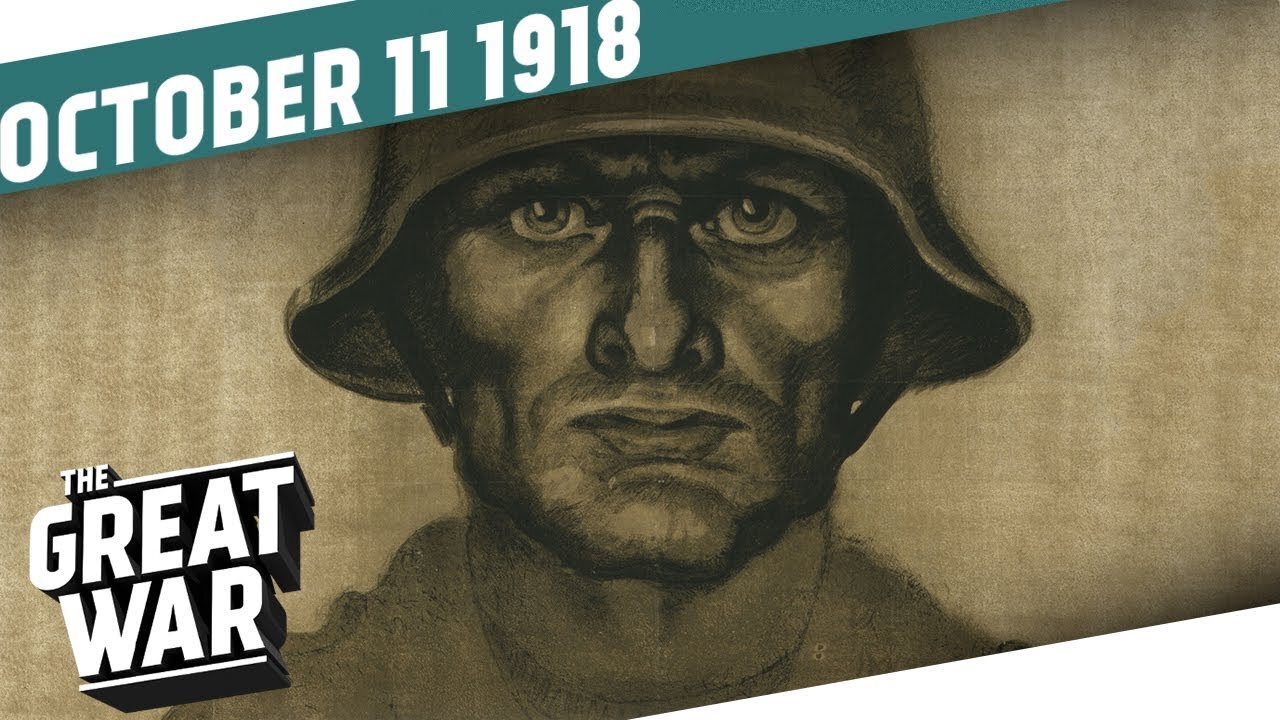
The Hindenburg Line or Siegfriedstellung is the backbone of the German defenses on the Western Front and this week 100 years ago, the Allies break through during the Battle of St. Quentin Canal. At the same time, the political fallout within Germany continues and the Allied Army of the Orient continues its offensive on the Macedonian Front.

As the Germans are retreating further and further during the Battle of the Selle, Erich Ludendorff – the German Quartermaster General, one half of Germany's military dictatorship and mastermind behind the last big German offensive in spring 1918 – resigns under pressure by the Kaiser and the Reichstag. The German upper class realizes that their days might be numbered if the war continues in the current form and Austria-Hungary's Emperor Karl has the same epiphany.

After the Battle of the Piave, the Italian front had been relatively quiet and stable. But just as unrest and instablity spread through the Austro-Hungarian Empire, the Italian Army and its allies attack along the whole front. From Monte Grappa and across the Piave, the Austro-Hungarians are caught off guard.

The Ottoman Empire has been on the retreat in the Middle East since the renewed British offensive in September and now, as the allies are threatening the Turkish heartland and also Constantinople, the Ottoman Empire calls for an armistice. The Armistice of Mudros is signed as the remaining Central Powers also struggle to keep their Empires together.

Unrest within the German Empire is spreading, resentment against the war, the hunger and the elites is turning into revolutionary action and with a mutiny in Kiel the wheels begin to turn quickly. Austria signs an armistice, the Macedonian Front collapses, Romania might enter the war again and the new German political leaders send a delegation through the lines in France. Their goal: An Armistice.

On November 11 1918, the German delegation and the Allies reach an agreement for an armistice. At the 11th hour the guns go silent and the First World War is over, well at least the guns go silent but is it a peace already? Germany is struggling with revolution and civil war at home, the break up of the Austro-Hungarian Empire causes a lot of chaos. And in Romania, the men are taking up arms again.